
I’ve been studying limerence for over a decade now, and I’ve done my absolute best to summarise what I’ve learned in my book, Smitten.
But one of the things about learning is that it never really stops. Knowledge just keeps compounding.
In this post, I’m going to show you a different way of looking at the problem of romantic obsession, and go through my new system for freeing yourself from unwanted limerence as quickly and efficiently as possible, and without wrecking your life.
We’re going to cover how limerence can spin out of control and become an obsession, why some of the common advice on how to handle it is wrong, and what actually has to happen, step by step, for you to recover your emotional and mental freedom.
And I’ll also tell you about how you can work with me directly—but we’ll save that for the end.
Part 1: How limerence goes wrong
So, the first thing I want to say is that I’m not antilimerence.
At least half the population of the world go through limerence as a natural part of the early stage of romantic love, and it feels fantastic.
It’s a massive, thrilling, exhilarating, euphoric sense of connection with another person. You want them more than you’ve ever wanted anything.
Limerence literally feels like an altered state of mind; a different operational mode for the brain. It can make the whole world seem brighter, more colourful and full of opportunity.
So, limerence can be brilliant if you are free to form a bond with your limerent object—that person that you’re head-over-heels for. Who wouldn’t want to surf a wave of bliss into an ecstatic union?
But…

Limerence can go wrong.
It’s an intoxicating natural high, and the problem with rewards that powerful is that they can become addictive.
If your brain runs in the limerence state for long enough, the dopamine-based reward system becomes sensitized. What was once a thrilling desire becomes a compulsive wanting. A craving that is very hard to resist.
Even worse, antireward systems in the brain can activate, and make separation from your limerent object stressful.
You end up with your mind spinning with intrusive thoughts that you can’t control. You panic when you have a bad interaction with them and think you might be losing the connection. You lie awake at night and endlessly replay old memories, torture yourself with what you wish you’d said or done, or rehearse what you are going to say the next time you speak with them.
That transition – from exhilarating highs to obsessive need – is most likely to happen if the limerent drive to form a pair bond with your limerent object is frustrated.
If there is uncertainty, or indecision, or social barriers, or some other reason why you can’t openly express your feelings.
When the limerent drive is constrained, it doesn’t disappear. It gets stronger.
That uncertainty could come from you not taking decisive action to start a romantic relationship, or it could come from a limerent object that gives you mixed messages; perhaps seems romantically interested in you sometimes, but other times is distant or cold.
Now, I’ve written a lot already about the neuroscience of limerence turning into addiction to another person, so I won’t go into more details here, but what I want to focus on here is that this is all instinctive behaviour.
You meet someone who seems unusually attractive – who causes a special glimmer of romantic excitement – and then just do what feels right. It’s nice being around them, you feel good, so you do more of it. But then, in small steps that you don’t individually notice, you accidentally train yourself into an infatuation that can turn into something darker and harder to manage.
You don’t realise it, but you’ve basically been playing Jenga with the foundations of your psychological stability:
A little flirting just to make life fun. A harmless fantasy that feels good. A quick look at their facebook profile to see their gorgeous face, and then…
Uh oh. Emotional collapse.

Sometimes the rubble that’s left to clear up is just your own heartache, but the consequences of unmanaged limerence can often affect other people too.
Part 2: When limerence is most destructive
There can be serious repercussions to an unplanned and unwanted episode of limerence—most obviously if you are married, or your limerent object is.
This is the commonest scenario I help people with.
They’re married, and generally happy—you know, not perfect, but fine—and then they are careless about their boundaries with a co-worker, or neighbour, or therapist, or the nice receptionist at the gym, or their kid’s new teacher, and they just follow their instincts, until *boom* they are well and truly limerent.
Then, they are forced to ask some really serious questions:
- Does this mean there’s something wrong with my marriage?
- How can I love my family but also have feelings this strong for someone else?
- Maybe what I believed about love is wrong?
- What do I really want out of my life?
- How do I get out of this mess without destroying everything I’ve built?
Marriage isn’t the only painful scenario of course.
Single people looking for love can end up limerent for someone who’s not good for them. Someone who is non-committal, or perhaps they’re masters of the mixed message. Perhaps they are just plain toxic or narcissistic.
Regardless of the particular circumstances, when limerence has reached the stage of person addiction, the same basic, very difficult, problem needs to be solved:
- I don’t want to feel like this anymore, but I can’t turn it off.
This is the point when the exhausting desire can feel like a psychological prison. You can’t concentrate, can’t sleep, and you want something that you know has become unhealthy.
Intellectually, you can want to escape from the limerent obsession, but emotionally it’s unbearable to think about letting go. Every option seems awful. No choice is appealing.
And just to make matters worse, limerence also scrambles your judgment. You can feel adrift from your old certainties. You can keep trying to do the right thing, but then the next time your limerent object glimmers at you, all your resolve breaks down.
And at the bottom of it all, the secret truth that makes everything harder, is that a part of you wants to fail.
Because then you get to keep the addictive hopes alive.
Part 3: The scale of the problem
OK. So, I think I’ve established the severity of destructive limerence.
How do you get out of it?
Well, an important first stage is understanding the scale of the problem.
Limerence at its root is a phenomenon of neuroscience—it exists within the brain. So, at a baseline, the first issue is that the strength of connections in the reward systems of the brain are altered, and that changes our thought processes.
But, that’s just the start.

Our reward system is, of course, integrated into all the other systems of the brain too. Most obviously, the emotional centres of the limbic system.
Overseeing all of this is the executive brain, the prefrontal cortex, which is supposed to regulate impulse control and provide context for reward-seeking behaviour.
All these systems can be modified during limerence, collectively, to result in the symptoms of the altered mental state of profound infatuation.
Now, while limerence is primarily a neuroscientific phenomenon, our brains aren’t separate from our bodies or our environments. The influences keep scaling.
Going beyond the internal world, other people can affect the intensity of a limerence episode. How the limerent object acts. How friends and family react.
We also need to think about how other people’s behaviour affects us in the context of our previous experiences—particularly around bonding to loved ones. So, our early life bonding within our family of origin is a big factor in how we make sense of romantic love.
And, so is the culture that we grow up within. All the love stories we read, romantic movies we watch, fairy tales we first hear in infancy.
And, if we’re going to go all the way to the top, the whole of evolutionary and social history supplies us with our instincts and the archetypes that haunt our collective unconscious.
That’s quite a lot of weight focused on a specific person at a specific moment in time.
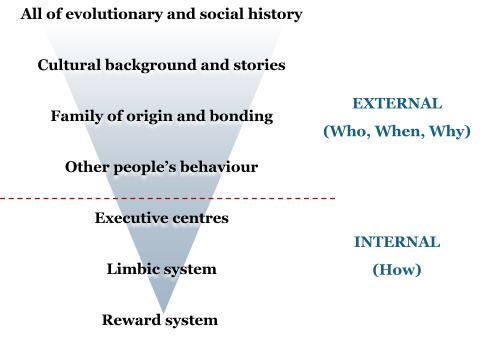
This is obviously a problem that needs to be simplified. To me, the best way to do this is to separate that giant inverted pyramid into two big categories.
The internal world is the “How” of limerence—the mechanics of how a particular person becomes a supernormal source of reward.
And, the external world, which is the Who When and Why parts of the phenomenon. Why them? Why now? What made me vulnerable?
The best ways to address the problems in those two categories are wildly different, and I think that is a cause for some solutions that seem on the surface to make sense, but in fact can actually backfire.
Part 4: What doesn’t work
The first potential problem is that therapists can simply ignore the mechanical part of limerence.
They focus on the highest levels of influences: What does your childhood bonding experience tell you about why you are attracted to unpredictable men? Why do you feel the need to save damsels in distress? What patterns of behaviour in the past are being replayed in the present?
Now, I’m not attacking this in principle.
It is obviously beneficial to ask these questions, and attempt to answer them.
It’s also very useful to think about the story you are telling yourself about your limerence—how you are making sense of it in terms of your deep beliefs about right and wrong, how good people behave, and what role the limerent object is playing in your life.
But.

All of that knowledge is illuminating, but it doesn’t change the strength of synaptic connections in the reward centres of your brain.
It’s high level life review. Context setting. Sense making. It doesn’t reverse the mental training that led into limerence in the first place.
Also, there is a danger that this approach continues the habit of ruminating about the limerent object to such an extent that they remain central in your mind.
The other common error that I see in terms of managing limerence, is mistaking overlapping symptoms for overlapping causes. For example: both limerence and OCD share the symptom of obsessive, intrusive thoughts, but that doesn’t mean that methods like exposure response prevention that desensitize the irrational fears of OCD, will work for the runaway desires of limerence.
Similarly, parallels have been drawn between limerence and borderline personality disorder, on the basis that both involve idealisation of the beloved, emotional instability and reduced executive control.
Again, the similarity in symptoms is mistaken for a common cause.
Now, BPD is a rare developmental disorder that persists through life. Limerence is a time-limited altered state that affects more than half the population of the world when they become infatuated.
The two conditions don’t have the same basis in neuroscience, and it’s far from clear that BPD treatments, which are mostly based on a better understanding of other people’s mental states and improving interpersonal skills, would be effective for limerence.
The best conceptual framework for understanding limerence is that it can become a behavioural addiction.
What starts as an intoxicating high, passes through a familiar progression of incentive sensitization, desire thinking loops, elaborated intrusion, and ultimately, a shift from positive reinforcement to negative reinforcement.
In other words: you used to want them because it felt so good, but now you need them to stop feeling bad.
That framework gives us a way into dealing with the problem.
Part 5: A plan for limerence recovery
Instead of starting at the top level and trying to understand how the whole sweep of your life has led you to this point, my approach starts at the foundational level of neuroscience.
Being trapped in limerence feels like losing your mental freedom. You can’t control your thoughts and feelings, and your willpower is exhausted.
We want to recover that mental freedom.
So, that’s our target.
In our way there are three types of barriers: neurological, emotional and practical.
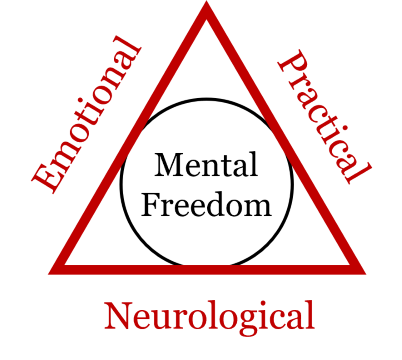
First, are the neurological barriers. These are the changes in the operation of the brain that I’ve been talking about that cause the symptoms of addiction. The cravings, the relentless wanting, the loss of executive control.
Second, are the emotional barriers. The intrusive thoughts, withdrawal pains, mood swings, anxiety, and also, often, feelings of guilt and shame about why you can’t regulate your feelings or live up to your ethical standards.
Third, there are practical barriers. How your limerent object behaves, how much contact with them you have (both direct and indirect like email and texting), how much control you have over your exposure to them, how your environment influences your thoughts about them.
To get free of limerence, you need to break down these barriers systematically.
You need to retrain your brain, develop emotional resilience, and take control of your interactions with your limerent object.
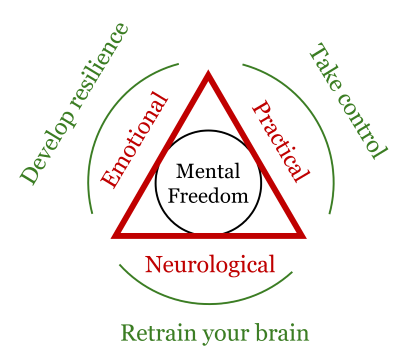
Now, for every individual limerent, the immediate priority will be different. The intensity of the different symptoms varies. But overall, there are some key stages that need to be passed.
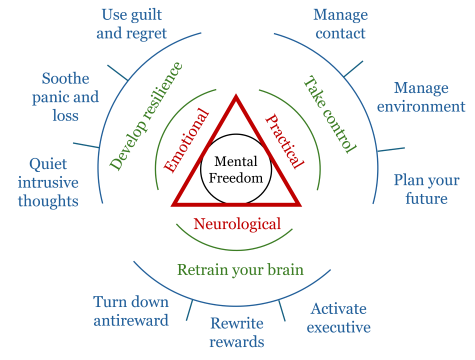
To retrain your brain you need to activate your executive brain—so, turn off autopilot mode, wake up your conscious mind, and start focusing your attention on the problem.
This is actually the most important step of all. It’s really important for shifting into a recovery mindset and starting to spot the patterns of instinctive behaviour that reinforce the limerent drive.
Next you need to work on reversing the changes in your reward systems. You need to rewrite the rewards that have slowly trained you into obsession, and turn down the intensity of the antireward systems that make the idea of losing access to your limerent object seem so appallingly unpleasant.
There are mental exercises that can help both overwrite the old daydreams and fantasies that have led into limerence, and to neutralise the stress response to the idea of deprivation.
These ideas are based in understanding the factors that reinforce reward-seeking behaviour and breaking the habits of mind that have built up over time to cement the obsession.
Next, are the emotional barriers. So here we need exercises that reduce the emotional impact of limerence: the rumination, intrusive thoughts, panic, grief, guilt and regret. So, the triggers for these emotions are obviously rooted in the neurological layer, but they go beyond that.
One of the hardest problems in limerence is the situation where you know you need to free yourself, but you can’t get your emotions to catch up to that reality.
They are still stuck, dependent on the limerent object.
In part, that’s because emotions very quickly get into feedback loops.
The initial urge or impulse that starts a limerent craving gets elaborated and built upon, drawing in old pains, formative romantic experiences, expectations about what love should feel like, personal insecurities, and so on and so on.
As we established earlier, there’s a big upside down pyramid of influences pushing down on our mood. We can’t realistically untangle all of those influences, so the plan is to be tactical. To use techniques from areas of psychology linked to regulation of the emotional drives in behavioural addiction.
These are techniques that quiet intrusive thoughts, and give you some relief from the endless thought loops that keep you awake at night. Techniques that help soothe the deprivation panic of losing your limerent object—and not just the panic, the longer, slower pain of the loss of a bond.
It’s easy to be dismissive of the pain of loss here. You know that the connection to your limerent object isn’t “real” or socially accepted. It’s a fantasy bond, rather than a mutual pair bond in a healthy relationship.
But it still hurts to break. It’s still a loss, it still causes grief.
It’s actually a form of what’s been called disenfranchised grief—grief that isn’t recognised by others as legitimate or proportionate. Grief you have to keep secret and nurse privately.
Finally, for many limerents, guilt and regret can be bundled up with all the addictive thrills and painful stresses of limerence.
The tactic here is slightly different. Instead of trying to suppress the guilt, we can use it.
Guilt can be a barometer for your internal moral state. Guilt can be analysed, and understood, and redirected into useful action to change your behaviour.
I’d also make an important distinction here between guilt and shame, or embarrassment. Shame is more about self-criticism, of running yourself down as a terrible person. That’s not useful or productive, but guilt is a signal that you’ve done something you regret because it runs against your values.
Using guilt can be constructive as you can change your behaviour, and possibly even find ways to make amends, and that will build confidence and self-esteem because you prove to yourself that you are in control of your choices.
So, for these emotional barriers, the goal is to turn down the volume on the emotions long enough to get through the worst resistance and naturally emerge from the altered mental state.
OK, so we’ve covered two of the barriers. The last is a little quicker as it covers the practical steps that you can take to change your old routines and engineer your environment to limit your exposure to your limerent object.
So, the first is a plan for managing contact.
This is both direct contact with your limerent object in person, and indirect contact, through all the many devices and channels that are available to us nowadays for getting a little secondary hit of exposure to them.
You need a plan for this, because improvising in the moment rarely works. Going cold turkey tends to backfire. Hoping your limerent object will change their behaviour for you out also usually fails.
So, a deliberate plan of staged withdrawal is usually the best approach. Reducing contact bit by bit, to taper off exposure and part on gradual terms.
There’s pitfalls here to be avoided: feeling you need closure, feeling you need to explain your reasons, oversharing, or using no contact as a way to try and precipitate disclosure. Where you finally admit your feelings and they…
…well this is why it’s a pitfall.
You don’t know what they are going to do, and that makes disclosure a high risk, low benefit action.
Unless you are free to form a relationship with your limerent object, disclosure is a bad idea.
OK, next is manage your environment.
When limerence is advanced, there are loads of cues in the environment that can make you think of your limerent object, and feed those thought loops and ruminations that keep the obsession going. So, you change your environment.
Obviously that means getting rid of any gifts or keepsakes that they gave you, but less obviously, changing your environment can also be a decisive act to psychologically mark a change in your attitude to limerence and your decision to end it.
And that brings us to the final piece of the puzzle, which is as important as that very first step of waking up your executive, and it’s planning for a better future.
It’s much easier to motivate yourself to take on the challenge of running through a sort of mental bootcamp of transformation, if you have a prize ahead of you at the end of the process.
You need to believe that you can emerge from the sometimes dark experience of limerence into a lighter, more purposeful, and meaningful life.
This is obviously a highly individual part of the process. What parts of your life you want to improve, what meaning means for you, what purpose you want to pursue, are all very personal choices. But there needs to be something.
It’s much easier to let go of the false hope of limerence if you have the true hope of a better life ahead of you.
All of this work is worthwhile if it transforms the psychological distress of unwanted limerence into personal renewal.
Think of it as taking that jumble of Jenga blocks and building a new tower that is taller and straighter and sturdier.
Handled well, this recovery plan can teach you important lessons about yourself that help you make better decisions about life and love in the future.
Conclusions
So, that’s how I’m thinking about limerence recovery these days.
Looking at this map of all the milestones to be passed, what jumps out at you? Can you find areas where you can really see your own struggles? Some of these issues will be huge for some limerents, but others might be fine. So, perhaps you’re really struggling with intrusive thoughts, but guilt isn’t a big problem in your situation.
So, the next step to take would be to find the one or two areas here that are major problems for you and go deeper.
There are also a lot of free resources here, and in particular, I’d highlight a couple of online tools you can use to analyse your own limerence vulnerabilities, and to analyse your limerent object’s behaviour, and so get a bit more clarity on your situation.
I’ve also created a workshop that addresses the big problem of obsessive thought loops because that tends to be one of the most distressing symptoms of limerence for people to deal with.
OK, thanks for sticking with me for this long and going through the new model. I really hope it was helpful.
I’m guessing if you’ve got this far, you see the value of the approach that I use, so I do also want to let you know that I’m now opening up a few slots for one to one coaching with individual clients, using this system to get you free of limerence.
I’ll take you through the process step by step. Identifying the biggest problems and constraints for you, and designing a personal recovery plan that targets each of the three big barriers in a strategic way.
So, if you need urgent help and direct support, click here to find out how to: work with me.
Leave a Reply